


Just thought I'd give an update on how the season has been going - and to be honest it’s been a bit rough, and I've learnt a few new lessons (sorry about the long post).
The first was in regards to 'bobtail flu', which I had always regarded as being just an extension of the RI (sniffles) that they so often get in damp or humid conditions. The strange conditions here last summer, with cool temperatures and a lot more rain continued for the rest of the year. Rain this year has been very odd for the west, with many more rainy days, but smaller falls on average. Over the winter I usually keep all my animals outside with few issues apart from the occasional cold (for which I bring them inside until it has passed). This winter, looking back my animals were probably not in the same condition they usually are going into cooling, especially given the very late birthing of the young last season. I battled through the winter bringing many animals than usual inside to escape the cold and wet and recover from various sniffles. Once September came I thought the worse was over and was looking forward to a more productive breeding season this year. All looked in good shape, including the young. For the first few weeks things went well, with plenty of mating activity and healthy active looking skinks. I did notice however that the adults were not eating anywhere near the usual amount for this time of year. Instead of gulping it down they were all picking at the food. I figured that so long as they were eating they were OK. Come October the weather again went haywire and we have had regular annoying rain and cooler temperatures. It seems just as things have dried out form the last fall another system comes in and soaks everything. By the end of October I noticed a couple of the bobtails and one of the bluies were starting to lose some condition. One of the bobtails I know is an old female so initially I thought maybe this was just an extension of her old age. Once the others started to drop weight I became a bit more worried. The blue tongue in particular was very difficult to feed. She was very small to start with, having been bought form a keeper who had not looked after her. I tried everything from all sorts of exotic fruits to raising silk moths. She would eat usually just enough to maintain her weight, then the next rainy period would come and she would stop eating again. I then noticed that most of my collection were showing signs of RI with deep breathing and mucus. This was a little different to previous RI with more copious thick mucus, but strangely they seemed outwardly less bothered by it (continuing usual behaviours, picking at food, and mating activity). 4 of them became quite ill and dropped further weight quite suddenly over about a week, with noticeable thinning of tail fat. At this time I contacted Kanyana Wildlife Park who seem to be specialists in looking after bobtails with this problem, which they describe perfectly with pictures on their website. I was reluctant to start force feeds but decided to begin before they lost anymore condition, and started by simply opening their mouths and gently pushing the food to the back of their throat to be swallowed. While this was effective it was very frustrating and time consuming. I am lucky to work at a hospital and was able to get the right tools to feed them more effectively without causing damage. I use a 20ml syringe attached to a soft silicone large bore catheter. A trick Kanyana taught me to open their mouths was to simply cover their eyes, and they will usually oblige. The tube was extended down the oral cavity past the tongue into the oesophagus, reaching about as far as between the shoulder blades. Food, water and any medicines were mixed to a slurry that could be easily injected down the feeding tube. Luckily the animals seem to accept this almost without any stress, and would relax soon after releasing them back into the enclosure. Initially I started treatment with Baytril (enrofloxacin) as described by Kanyana. Due to the possible teratogenic effects of baytril I did some research and changed to a different antibiotic with broader spectrum and fewer know toxic effects. Despite cleaning their eyes almost daily to clear mucous many of them had eyes that were closing over. I therefore started to apply regular chlorsig 1% ointment with immediate improvement. Despite my best efforts I lost one of my bobtails and the little bluetongue. The rest however have now started to recover. Most have begun to eat with their usual ferocity and are putting on some weight finally. I am still tube feeding 2 females, one of whom is gravid.
Notwithstanding it is looking like another poor breeding season with likely only 3 gravid females, I think I was lucky in the end that I did not lose more animals. Looking back I waited too long to start treatment, fooled by my past experience, the fact they were still eating, and my waiting for the weather to improve. I have changed my view that bobtail flu is just an extension of the sniffles. This was quite different and very insidious in nature. It seemed that the respiratory symptoms were amongst the last to appear. I would love to know the causative agent, which hopefully someone will identify in the future.
My next bit of eye opening was with sexing methods, with which I thought I was quite comfortable with. This was all changed one afternoon when I came out to find one of my favourite orange "females" aggressively mating with her house mates. I did wonder if this was just due to a seasonal change in hormones making her act masculine. When I checked under her tail I was a little surprised to see to large engorged veins, absolutely typical of males. With other females I may have put it down to incorrect sexing initially, except with this one I was quite sure. I had separated her prior to giving birth last season, and therefore I know my little orange baby belongs to her. The behaviour and veins were present for about 2 weeks and I even began to question the possibility of her changing sex. Now that the mating season is over I checked gain today and the (?hemi penile) veins have gone and she once again looks quite female.
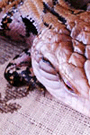
The final curve ball of the season was the appearance of scale rot on a few of my animals, especially the babies - something I had never seen before. I wondered if it had something to do with them being run down from the other infection, except that the scale rot seemed to affect the babies more, where they were largely spared from any symptoms of flu. I started treatment with iodine wash, to good effect. I did not think it could be due to unsanitary conditions as they live in a very large enclosure ( approx 14m by 1.5m), with any waste being quickly removed by the various natural micro fauna. Despite this I decided to clear out the whole enclosure just in case. All the animals seem to have their own favourite hides and the babies in particular seem to like to bed down together. It was when I was cleaning their usual bedding spot I realised who the culprit was (scroll down for picture of the offender). Luckily this time it was a much easier problem to solve, although she was a little miffed to give up her favourite spot for toileting...





 ). One afternoon in Perth it was about 28*C and we had a downpour of rain. Very tropical. All the plants liked it but it wasn't what I would call typical Perth weather.