
Blue tongues.
Forum rules
In this forum all are welcome to ask blue tongue skink-related questions, share information, ideas, tips, experiences, and pictures with fellow BTS enthusiasts.
If you are wondering if your BTS is acting normally or might be sick, this is where you can get help with that.
This is also where you can have some FUN while sharing the enjoyment you get from your blueys!
In this forum all are welcome to ask blue tongue skink-related questions, share information, ideas, tips, experiences, and pictures with fellow BTS enthusiasts.
If you are wondering if your BTS is acting normally or might be sick, this is where you can get help with that.
This is also where you can have some FUN while sharing the enjoyment you get from your blueys!
-
jesswebb93
- Bluey Beginner

- Posts: 66
- Joined: Mon Jan 19, 2015 6:26 pm
- Country:
- Location: Florida, United States
Blue tongues.
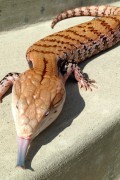
I apologise if this topic/question has been brought up before, but I've been curious about it for a while now. Why is it that some subspecies vary in amount of blueness on their tongues? The photos below demonstrate how my Halmahera (top picture) has half a blue tongue, whereas my Irian Jaya has a full blue tongue. I find it rather interesting, does anyone have any idea why that could be?
You do not have the required permissions to view the files attached to this post.
-
alichamp

- Moderator

- Posts: 749
- Joined: Sun Mar 08, 2015 8:50 pm
- Country: Australia
- Location: NSW
Re: Blue tongues.
My guess would be genetic variation between individual skinks.
-
Dakota

- Snail Hunter

- Posts: 5212
- Joined: Fri Mar 01, 2013 3:30 pm
- Your Facebook name: Dakota Nivens
- Country: US
Re: Blue tongues.
I have found myself wondering the same question. I am actually going to school to be an evolutionary biologist, and this is one thing I plan to study. It really depends on the evolutionary history of how Tiliqua came to be, whether they migrated south into Australia or north into Indonesia — the latter being mostly agreed on (likely because fossil records have been found in eastern Australia), though (unless I'm mistaken) quite the opposite happened for the pythons of Australia. With this being said, we cannot assume they are actually losing color, nor simply their Australia counterparts (and Tiliqua gigas evanescens for the most part) gained it. The lack of a feature usually means they don't need it, so I hypothesize the lowland rainforest dwellers such as Tiliqua gigas gigas may not have found such use of their namesake feature with the help of the dense canopy and vegetation they scurry in. This is purely my hypothesis, and could very easily be proven wrong. A counterargument to my hypothesis would be the fact even some Australian Tiliqua have pink tongues. It has been posted (especially of the Tasmanian lowland T. nigrolutea) showing they also have less blue in some individuals; there has even been a T. occipitalis posted with a completely pink tongue. So, it is hard to give a definite answer, but it is pretty consecutive that Tiliqua gigas gigas have less blue tongues on average than the other species. Whether or not this feature is considered vestigial in relation to Tiliqua gigas ssp., I cannot answer that. Further studies need to be done.
"The love for all living creatures is the most noble attribute of man." — Charles Darwin
-
jesswebb93
- Bluey Beginner
- Posts: 66
- Joined: Mon Jan 19, 2015 6:26 pm
- Country:
- Location: Florida, United States
Re: Blue tongues.
Dakota wrote:The lack of a feature usually means they don't need it, so I hypothesize the lowland rainforest dwellers such as Tiliqua gigas gigas may not have found such use of their namesake feature with the help of the dense canopy and vegetation they scurry in. This is purely my hypothesis, and could very easily be proven wrong. A counterargument to my hypothesis would be the fact even some Australian Tiliqua have pink tongues. It has been posted (especially of the Tasmanian lowland T. nigrolutea) showing they also have less blue in some individuals; there has even been a T. occipitalis posted with a completely pink tongue. So, it is hard to give a definite answer, but it is pretty consecutive that Tiliqua gigas gigas have less blue tongues on average than the other species. Whether or not this feature is considered vestigial in relation to Tiliqua gigas ssp., I cannot answer that. Further studies need to be done.
Interesting hypothesis, Dakota. Thanks for your input. Hopefully, there'll be studies in the future that answer this question fully. I find it rather interesting that IJ Blueys are from areas of Indonesia and Papua New Guinea and have a similar climate, environment etc as the Halmahera, yet they have full blue tongues unlike the Halmahera.
-
Susann
- ADMIN

- Posts: 4022
- Joined: Mon Mar 22, 2010 12:06 pm
- Country: USA
- Location: Utah
Re: Blue tongues.
I thought all the gigas had the half-blue tongues... Certainly all my Meraukes do. What are Kei tongues like?
Breeder and keeper of Meraukes from 2010 to 2022.
-
Dakota
- Snail Hunter
- Posts: 5212
- Joined: Fri Mar 01, 2013 3:30 pm
- Your Facebook name: Dakota Nivens
- Country: US
Re: Blue tongues.
My Meraukes have pretty blue tongues.
I haven't noticed any pink in the Keis, but their tongues seem darker.
I haven't noticed any pink in the Keis, but their tongues seem darker.
You do not have the required permissions to view the files attached to this post.
"The love for all living creatures is the most noble attribute of man." — Charles Darwin
-
alichamp
- Moderator
- Posts: 749
- Joined: Sun Mar 08, 2015 8:50 pm
- Country: Australia
- Location: NSW
Re: Blue tongues.
Sorry this topic hasn't really taken off here. I found these old threads that you may find interesting but they don't really answer your question. 
Tongue color
What makes a blue tongue skink's tongue blue?
Tongue color
What makes a blue tongue skink's tongue blue?
-
NickBrahz

- The Undecider
- Posts: 858
- Joined: Sun Jan 11, 2015 8:09 pm
- Country: Australia
- Location: Sydney
Re: Blue tongues.
Had a gander at my 3 bubs, 2 Easterns and a Highland/Alpine blotch and they all have full coloured tongues similar to colour as Dakota's Meraukes
-
Susann
- ADMIN
- Posts: 4022
- Joined: Mon Mar 22, 2010 12:06 pm
- Country: USA
- Location: Utah
Re: Blue tongues.
My male Merauke Milo (like the alliteration there?):
Merauke Maddie :
Merauke Maddie
:You do not have the required permissions to view the files attached to this post.
Breeder and keeper of Meraukes from 2010 to 2022.
-
alichamp
- Moderator
- Posts: 749
- Joined: Sun Mar 08, 2015 8:50 pm
- Country: Australia
- Location: NSW
Re: Blue tongues.
According to http://www.bluetongueskinks.net/ one of the listed 'distinguishing marks' for the Indonesian BTS (T. gigas gigas) is:
• Tongue is typically a very light shade of blue which turns pink at about the halfway point
We have seen just on this thread variation between meraukes (T. gigas evanescens) so perhaps it doesn't apply to all gigas (more room for individual variation?).
For anyone who has a copy of the BTS "bible" on hand (Blue-Tongued Skinks: Contributions to Tiliqua and Cyclodomorphus) - is tongue colour described at all?
• Tongue is typically a very light shade of blue which turns pink at about the halfway point
We have seen just on this thread variation between meraukes (T. gigas evanescens) so perhaps it doesn't apply to all gigas (more room for individual variation?).
For anyone who has a copy of the BTS "bible" on hand (Blue-Tongued Skinks: Contributions to Tiliqua and Cyclodomorphus) - is tongue colour described at all?
-
Dakota
- Snail Hunter
- Posts: 5212
- Joined: Fri Mar 01, 2013 3:30 pm
- Your Facebook name: Dakota Nivens
- Country: US
Re: Blue tongues.
What a thought-provoking thread. I like it!
Yes, there is a whole chapter dedicated to it called, "Functionality of the blue tongue in blue-tongued skinks (Tiliqua sp.)".
Here is a phone picture of the page that goes into detail a bit:
You may need to click on the attachment to read it.
Anyhow, you can see they were only mentioning hypotheses.
It does mention the lack of blue in Pink-tongued skinks, but they seem to draw the hypothesis that maybe only juvenile need it. Which in part, I agree with — juvenile Hemisphaeriodon likely do not climb as high as the adults, thus requiring the blue tongue only at an early age. Closer to the ground may equate to more immediate predators, requiring the need for a defense mechanism.
Meraukes and Irian Jaya are not found strictly in dense rainforest such as most of the range of T. g. gigas, so this is why I think there is a lot of variation among them. I can honestly say I have yet to see a Halmahera with a full blue tongue. Not saying it is impossible, because I'm sure some are out there.
We need more organismal ecologists and evolutionary biologists studying Tiliqua.
And on another note, I have caught my Halmahera, Maxx, doing a threat display on my phone video camera, and the only color you see is pink.
Yes, there is a whole chapter dedicated to it called, "Functionality of the blue tongue in blue-tongued skinks (Tiliqua sp.)".
Here is a phone picture of the page that goes into detail a bit:
You may need to click on the attachment to read it.
Anyhow, you can see they were only mentioning hypotheses.
It does mention the lack of blue in Pink-tongued skinks, but they seem to draw the hypothesis that maybe only juvenile need it. Which in part, I agree with — juvenile Hemisphaeriodon likely do not climb as high as the adults, thus requiring the blue tongue only at an early age. Closer to the ground may equate to more immediate predators, requiring the need for a defense mechanism.
Meraukes and Irian Jaya are not found strictly in dense rainforest such as most of the range of T. g. gigas, so this is why I think there is a lot of variation among them. I can honestly say I have yet to see a Halmahera with a full blue tongue. Not saying it is impossible, because I'm sure some are out there.
We need more organismal ecologists and evolutionary biologists studying Tiliqua.
And on another note, I have caught my Halmahera, Maxx, doing a threat display on my phone video camera, and the only color you see is pink.
You do not have the required permissions to view the files attached to this post.
"The love for all living creatures is the most noble attribute of man." — Charles Darwin
Return to “General Discussion and FAQ”
Who is online
Users browsing this forum: No registered users and 204 guests