
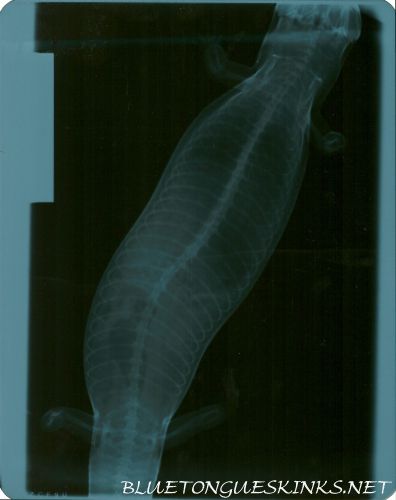
Hi, I got the bts the day before yesterday and I'am worried about the shape of his back. Does it look like MBD? Or maybe it is the normal skeleton shape of young skinks(too skinny)?
http://www.youtube.com/watch?v=OaDzGEZp18Y
Is it MBD[Rachitis]? Tiliqua gigas
Forum rules
In this forum all are welcome to ask blue tongue skink-related questions, share information, ideas, tips, experiences, and pictures with fellow BTS enthusiasts.
If you are wondering if your BTS is acting normally or might be sick, this is where you can get help with that.
This is also where you can have some FUN while sharing the enjoyment you get from your blueys!
In this forum all are welcome to ask blue tongue skink-related questions, share information, ideas, tips, experiences, and pictures with fellow BTS enthusiasts.
If you are wondering if your BTS is acting normally or might be sick, this is where you can get help with that.
This is also where you can have some FUN while sharing the enjoyment you get from your blueys!
-
Ser-J

- Bluey Beginner

- Posts: 9
- Joined: Fri Nov 12, 2010 4:05 pm
- Country:
Is it MBD[Rachitis]? Tiliqua gigas
sorry for my english:)
-
WanderingChai

- Bluey Enthusiast

- Posts: 627
- Joined: Sat May 21, 2011 6:11 pm
- Country:
- Location: New York
-
Alioop

- Loopy De Loop

- Posts: 2648
- Joined: Sat Jul 26, 2008 7:37 pm
- Country:
- Location: Buffalo, NY
He is very young to have already developed such severe MBD, it is more likely a birth defect. Either way, a vet visit is needed to accurately diagnose and effectively treat his condition.
Gorgeous little skink btw
Gorgeous little skink btw
Do not go where the path may lead, go instead where there is no path and leave a trail.
-Alie-
1.0 Irian Jaya
1.1 Easterns
-Alie-
1.0 Irian Jaya
1.1 Easterns
-
Coomassie

- The Inked Chemist

- Posts: 1826
- Joined: Thu Nov 04, 2010 5:01 pm
- Country:
- Location: Newark, DE
-
Katrina

- The Daredevil

- Posts: 9769
- Joined: Sun Dec 02, 2007 3:34 pm
- Country:
- Location: Alberta, Canada
Alioop wrote:He is very young to have already developed such severe MBD, it is more likely a birth defect. Either way, a vet visit is needed to accurately diagnose and effectively treat his condition.
Gorgeous little skink btw
Exactly what Ali said - too young to have MBD, but definitely see a vet.
Poor little guy looks terrified. Very pretty little one!
-
christian
- Bluey Beginner
- Posts: 36
- Joined: Fri Sep 24, 2010 9:35 pm
- Country:

-
James Wilson

- The Mentor
- Posts: 693
- Joined: Mon Feb 16, 2004 8:01 am
- Country:
- Location: San Diego, California
Definitely a birth defect. This happens when gravid females are kept at temps that are too cool, and not allowed proper basking sites. Unfortunately, this situation is most common with wild collected gravid females that give birth while at the importer/whosaler or the petstore. The situation is covered in my previous writings that I will include below.
Spinal Deformities
On occasion I have seen Blue-tongued Skinks with spinal deformities. Spinal deformities do not always share the same causal factors. So before you come to any conclusions you must weigh all of the factors, or you could make matters even worse. One thing that you can count on is that these things do not just randomly happen, they are almost always, either directly or indirectly, the result of improper husbandry.
Metabolic bone disease can cause serious spinal deformities and often proves fatal if not treated properly. Young skinks that are still in the growing process need extra calcium in order for their bones to properly develop. Because of this, they are the most susceptible to this condition. I have seen this occur in baby skinks that were given calcium supplements that contained added phosphorous (added phosphorous cancels out the positive affects of the calcium). With proper and timely treatment physical manifestations, such as spinal deformities, can generally be arrested, but not reversed.
Often spinal deformities in neonate blue-tongues are incorrectly attributed to metabolic bone disease, but are actually thought, by the author, to be the result of what happens when gravid females are not given access to adequate basking temperatures. I have a friend who purchased a large, obviously gravid, blue-tongue from one of the big pet store chains. This large female was an imported Irian Jaya Blue-tongue that had been kept at room temperature for her two-month stay at the pet store. She gave birth to 10 baby skinks 1 day after she was brought home. These babies had spines that appeared to be too large for their bodies, causing many of them to be contorted into little C shapes that were twisted so that the rear ventral region was facing up. There were a couple of these little skinks whose bodies looked like inchworms, causing them to tip over onto their sides each time they attempted to move. The others were able to use their front legs to crawl in circles. Three of the babies died shortly after birth, and the remaining seven were given to me in hopes that I could keep them alive. Most Vets do not give a very optimistic prognosis for babies born with these deformities, and freezing them was recommended as the best alternative. However, my wife was able to keep 4 of the original 7 alive by hand feeding and watering them every day. It was not long till most of them were eating on their own, although they still were hardly mobile. In time as they grew, their bodies seemed to accommodate their spinal deformities, allowing them to straighten out to some extent. Two of them appeared almost normal, having only curly tail tips as a reminder of their previous disability, while the others had wavy spines of various degrees. Although many people suggested that we put them down, these baby skinks fought hard to live, and have all been adopted out to good homes. I mention this situation as an example of what can be avoided by simply providing a proper basking site for gravid females.
I have also seen spinal deformities result in skinks that try to climb up one of the corners of their glass cage, forcing their mid-body into an L shape. When skinks stay in this kind of an unnatural position for long periods of time, on a regular basis, spinal deformities may result. This behaviour is usually caused by something lacking in the skink's environment causing it to attempt an escape. It could be due to improper temperatures, or the skink may be feeling vulnerable, causing it to seek adequate shelter. Skinks do not understand glass as a solid object, which is why some "unhappy" specimens keep climbing up the same corner over and over. If your skink does this, try to find out what is wrong with the enclosure, and you may also want to consider a custom cage with solid walls.
Spinal Deformities
On occasion I have seen Blue-tongued Skinks with spinal deformities. Spinal deformities do not always share the same causal factors. So before you come to any conclusions you must weigh all of the factors, or you could make matters even worse. One thing that you can count on is that these things do not just randomly happen, they are almost always, either directly or indirectly, the result of improper husbandry.
Metabolic bone disease can cause serious spinal deformities and often proves fatal if not treated properly. Young skinks that are still in the growing process need extra calcium in order for their bones to properly develop. Because of this, they are the most susceptible to this condition. I have seen this occur in baby skinks that were given calcium supplements that contained added phosphorous (added phosphorous cancels out the positive affects of the calcium). With proper and timely treatment physical manifestations, such as spinal deformities, can generally be arrested, but not reversed.
Often spinal deformities in neonate blue-tongues are incorrectly attributed to metabolic bone disease, but are actually thought, by the author, to be the result of what happens when gravid females are not given access to adequate basking temperatures. I have a friend who purchased a large, obviously gravid, blue-tongue from one of the big pet store chains. This large female was an imported Irian Jaya Blue-tongue that had been kept at room temperature for her two-month stay at the pet store. She gave birth to 10 baby skinks 1 day after she was brought home. These babies had spines that appeared to be too large for their bodies, causing many of them to be contorted into little C shapes that were twisted so that the rear ventral region was facing up. There were a couple of these little skinks whose bodies looked like inchworms, causing them to tip over onto their sides each time they attempted to move. The others were able to use their front legs to crawl in circles. Three of the babies died shortly after birth, and the remaining seven were given to me in hopes that I could keep them alive. Most Vets do not give a very optimistic prognosis for babies born with these deformities, and freezing them was recommended as the best alternative. However, my wife was able to keep 4 of the original 7 alive by hand feeding and watering them every day. It was not long till most of them were eating on their own, although they still were hardly mobile. In time as they grew, their bodies seemed to accommodate their spinal deformities, allowing them to straighten out to some extent. Two of them appeared almost normal, having only curly tail tips as a reminder of their previous disability, while the others had wavy spines of various degrees. Although many people suggested that we put them down, these baby skinks fought hard to live, and have all been adopted out to good homes. I mention this situation as an example of what can be avoided by simply providing a proper basking site for gravid females.
I have also seen spinal deformities result in skinks that try to climb up one of the corners of their glass cage, forcing their mid-body into an L shape. When skinks stay in this kind of an unnatural position for long periods of time, on a regular basis, spinal deformities may result. This behaviour is usually caused by something lacking in the skink's environment causing it to attempt an escape. It could be due to improper temperatures, or the skink may be feeling vulnerable, causing it to seek adequate shelter. Skinks do not understand glass as a solid object, which is why some "unhappy" specimens keep climbing up the same corner over and over. If your skink does this, try to find out what is wrong with the enclosure, and you may also want to consider a custom cage with solid walls.
James Wilson
-
Jeff

- Vladik Pippery
- Posts: 5684
- Joined: Thu Sep 18, 2008 3:33 pm
- Country:
- Location: Arizona, USA
- Contact:
Thanks for that James. As you know, I had the one baby with a deformed spine this year. That baby was one in a litter of 14, and the other 13 were all perfect. Do you have any idea why just one baby would have this issue? The weirdest thing to me is that the deformed baby was the first one born of the litter. All the other babies were fine.
In my case, the deformed baby has always eaten well, and is growing at a pretty normal rate. He also seems to have fairly normal mobility.
I am shocked that this baby has survived this long due to the extent of its deformity. In addition to his spinal deformity, He also has a head deformity. I am sure the conventional wisdom is to just cull an animal in this condition, but there is no indication whatsoever that this little guy is in any discomfort at all, so I am firmly committed to caring for him as long as he lives.
Sorry to the OP for hijacking the thread. I agree 100% that the issue is a birth defect rather than MBD. Of course, the birth defect may have the same cause as MBD, only in vitro.
In my case, the deformed baby has always eaten well, and is growing at a pretty normal rate. He also seems to have fairly normal mobility.
I am shocked that this baby has survived this long due to the extent of its deformity. In addition to his spinal deformity, He also has a head deformity. I am sure the conventional wisdom is to just cull an animal in this condition, but there is no indication whatsoever that this little guy is in any discomfort at all, so I am firmly committed to caring for him as long as he lives.
Sorry to the OP for hijacking the thread. I agree 100% that the issue is a birth defect rather than MBD. Of course, the birth defect may have the same cause as MBD, only in vitro.
6.10.9 T. s. intermedia
2.2.7 T. s. scincoides
1.2.1 T. nigrolutea
2.2.0 T. r. rugosa
1.2.3 T.g. keyensis
2.0.5 T.s. chimaera
0.0.0. T. occipitalis
0.0.0. T. multifasciata
http://www.btskinks.com
https://www.facebook.com/pages/Bluetong ... 846297977#
2.2.7 T. s. scincoides
1.2.1 T. nigrolutea
2.2.0 T. r. rugosa
1.2.3 T.g. keyensis
2.0.5 T.s. chimaera
0.0.0. T. occipitalis
0.0.0. T. multifasciata
http://www.btskinks.com
https://www.facebook.com/pages/Bluetong ... 846297977#
-
Alioop
- Loopy De Loop
- Posts: 2648
- Joined: Sat Jul 26, 2008 7:37 pm
- Country:
- Location: Buffalo, NY
-
James Wilson
- The Mentor
- Posts: 693
- Joined: Mon Feb 16, 2004 8:01 am
- Country:
- Location: San Diego, California
Jeff, I do not believe that there is an environmental causal factor in your situation. I am convinced that it was an actual birth defect, most likely due to a genetic bad luck of the draw. Its a numbers game, and if you produce enough babies, you are bound to get a bad genetic roll of the dice sooner or later. Most of the Northerns here in the US come from one source, and as a result, many are related distantly if not directly. So it is no wonder that this sort of thing shows up from time to time. One thing I am sure of, and that is that your little "mutant" is not the result of any husbandry issues on your part.
James Wilson
-
Ser-J
- Bluey Beginner
- Posts: 9
- Joined: Fri Nov 12, 2010 4:05 pm
- Country:
Thank you for replies! Especially to James Wilson for the information.
I skyped the seller today and he told me the bts was fine when he sent him to me. He is pretty sure the skink has dislocation of vertebras because it was dropped or something else he doesn't know.
I've already gotton a bts from him before and I am sure the seller isn't a liar but I think he could be mistaken.
Doesn't seem that the bts feels pain when moves.
Unfortunately there aren't any vets where I live
I skyped the seller today and he told me the bts was fine when he sent him to me. He is pretty sure the skink has dislocation of vertebras because it was dropped or something else he doesn't know.
I've already gotton a bts from him before and I am sure the seller isn't a liar but I think he could be mistaken.
Doesn't seem that the bts feels pain when moves.
Unfortunately there aren't any vets where I live
sorry for my english:)
-
WanderingChai
- Bluey Enthusiast
- Posts: 627
- Joined: Sat May 21, 2011 6:11 pm
- Country:
- Location: New York
-
Ser-J
- Bluey Beginner
- Posts: 9
- Joined: Fri Nov 12, 2010 4:05 pm
- Country:
I am from Russia. Now I live in the village and I don't have a car. Even if I had it I got to go to Moscow because I don't know any other herps. I have written a post on the forum where the herp answers and if she tell me that there is something she can do I'll send the skink to Moscow. I'm not able to do more now.
The skink doesn't look very healthy but I don't think it's going to die. He eats and has normal behaviour.
The skink doesn't look very healthy but I don't think it's going to die. He eats and has normal behaviour.
sorry for my english:)
-
Nae

- Forum Graphic Designer

- Posts: 1889
- Joined: Tue Nov 23, 2010 4:30 am
- Country:
- Location: Western Australia
-
Ser-J
- Bluey Beginner
- Posts: 9
- Joined: Fri Nov 12, 2010 4:05 pm
- Country:
I don't think an X-ray can show somthing.
One of my skinks had a forearm fracture. And I was told that an X-ray wouldn't show anything although that bts was a little bigger.
I was told the bts is too young for having MBD(Rachitis) but it is at least 1 month old. Maybe it is MBD(Rachitis)? Could it appear so quickly?(about 24 hours)
I have read posts on our russian forum like "I bought a bts in our local pet store. At first it was fine but now(after one or two days) he's got a big hump on his back."
In that cases skinks were much bigger than mine.
Only they all had deformations on their sacrum.
One of my skinks had a forearm fracture. And I was told that an X-ray wouldn't show anything although that bts was a little bigger.
I was told the bts is too young for having MBD(Rachitis) but it is at least 1 month old. Maybe it is MBD(Rachitis)? Could it appear so quickly?(about 24 hours)
I have read posts on our russian forum like "I bought a bts in our local pet store. At first it was fine but now(after one or two days) he's got a big hump on his back."
In that cases skinks were much bigger than mine.
Only they all had deformations on their sacrum.
sorry for my english:)
-
xxmonitorlizardxx

- Walks with Squirrels
- Posts: 4050
- Joined: Mon Apr 26, 2010 7:06 pm
- Your Facebook name: Jeremy Johnson
- Country:
- Location: NJ, USA
-
Bird_Brain

- The Happy Hitman
- Posts: 4079
- Joined: Sat Nov 04, 2006 7:11 pm
- Country:
- Location: Warren, Indiana
-
reaperreptiles

- Bluey Follower

- Posts: 298
- Joined: Fri May 20, 2011 1:10 pm
- Country:
- Location: Hephzibah, GA
I am sorry for hijacking the thread again, but what jeff siad about one baby being deformed. Could it be possible that with such a large litter that maybe the other offspring put too much pressure on the baby or were genetically stronger thus absorbing more calcium and needed nutrients/food. You see this in many animals, even humans, that have large amounts of offspring. usually one or two seem to be weaker or have 'issues' (in mammals especially) almost always caused by a lack of nutrition to that baby bc of the massive amount of other offspring. just curious if this ever happens in the reptile world.
-Cheyenne (thats shy-anne)
0.1 caramel northern(Toblerone/Toby for short)
0.0.1 caramel northern(Mr.Tubbins)
0.0.1 northern (Beetlejuice)
0.1 caramel northern(Toblerone/Toby for short)
0.0.1 caramel northern(Mr.Tubbins)
0.0.1 northern (Beetlejuice)
-
James Wilson
- The Mentor
- Posts: 693
- Joined: Mon Feb 16, 2004 8:01 am
- Country:
- Location: San Diego, California
reaperreptiles wrote:I am sorry for hijacking the thread again, but what jeff siad about one baby being deformed. Could it be possible that with such a large litter that maybe the other offspring put too much pressure on the baby or were genetically stronger thus absorbing more calcium and needed nutrients/food. You see this in many animals, even humans, that have large amounts of offspring. usually one or two seem to be weaker or have 'issues' (in mammals especially) almost always caused by a lack of nutrition to that baby bc of the massive amount of other offspring. just curious if this ever happens in the reptile world.
It is possible. The litter was pretty large, and the babies were pretty big as well. That being said, the mother was a HUGE specemin. It is impossible to know for sure what caused it. I am just glad it is in Jeff's care.
James Wilson
-
reaperreptiles
- Bluey Follower
- Posts: 298
- Joined: Fri May 20, 2011 1:10 pm
- Country:
- Location: Hephzibah, GA
Return to “General Discussion and FAQ”
Who is online
Users browsing this forum: No registered users and 291 guests