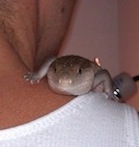
Drew wrote: hmmm..arent Easterns supposed to have eye bands like ninja bands?

As others have mentioned, not all easterns have eye bands, and yours is a perfect example of that. There are many things things to pay attention to when identifying BTS species, subspecies, and undescribed forms. That being said, there two easy tips that will help with the Irian Jaya vs Eastern question. Patternless pale front legs are a scincoides trait that the Irian Jaya rarely ever displays. In addition, that short fat tail is also a Scincoides trait that you will not see on the Irian Jaya. The Gigas influence in what helped to make what we know as the Irian Jaya BTS still shows through in their longer tails and patterned front legs. That being said, these traits are shown on the Irian Jaya in varifying degrees, and there are times it can still be tricky. As a result, I will include my descriptions and information on the Eastern, and the Irian Jaya. The information here should answer alot of questions about these two forms and the confusion that often surronds them. I will also post a new seperate post with a Tiliqua species key along with scincoides and gigas subspecies keys as well. I hope it helps.
Eastern Blue-tongued Skink Tiliqua scincoides scincoides
The Eastern Blue-tongued Skink was very popular and common in the in the US hobby back in the 1980s, but was later cast aside by collectors and breeders who were more interested in the larger northern blue-tongue (intermedia) which was very expensive at the time. Ironically, because of the sudden interest shift in breeding efforts, the Eastern Blue-tongued Skink is currently very hard to find in the US hobby, causing it to now be very desirable and expensive. When they are available, they often look suspiciously like intergrades, or northern blue-tongues. I have seen northern blue-tongues being marketed as eastern blue-tongues on more than one occasion.
Description: The Eastern blue-tongue is variable in color, but usually has a grey to tan background color with darker bands that extend over the back onto the sides, and sometimes continuing onto the belly. The scales of the paler interspaces (between the darker bands) are usually marked with dark lateral edges, creating a series of thin dark brown lines that run down the length of the body. Many (but not all) specimens possess a heavy, dark brown or black, temporal streak that starts at the back of the eye and runs back to the top of the ear opening. Their forelimbs are basically patternless, and are always much lighter in color than the hind limbs. The anterior temporal scales on the Eastern blue-tongue are elongated and much longer than the other temporal scales. This skink has 34-40 mid-body scale rows, and its tail accounts for 50-60% of the snout-vent length, and it often appears to be thicker than the other three subspecies. Average adult size for this subspecies is 17-19 inches (43-48 cm), with some individuals growing as large as 21 inches (53 cm). Females can produce 10 to 20 live young in a litter.
Distribution and habitat: The Eastern blue-tongued skink can be found in south-eastern South Australia and throughout the majority of Victoria, New South Wales, and southern Queensland, where its range moves north up the east coast along the Cape York Peninsula.
The Eastern blue-tongued skink has also been observed in a small isolated population in extreme north-western South Australia about 600 miles away from the nearest point of the range that they were previously thought to be restricted to. The existence of this population was first reported in 1992, by G.R. Johnston, in the Transactions of the Royal Society of South Australia. He was unable to determine whether they were naturally occurring. However, the local aboriginal people had known of them for a long time. The Eastern blue-tongue inhabits a wide variety of habitats, including coastal woodlands, montane forests, and semi-arid grasslands.
Irian Jaya Blue-tongued Skink Tiliqua ssp.
(Currently undescribed)
The Irian Jaya blue-tongued skink was recently discovered in the early 1990s, and currently remains undescribed and unnamed. Many hobbyists believe it to be a 4th scincoides subspecies. For the first few years after the Irian Jaya blue-tongue's discovery, it was considered quite rare, and it carried a very expensive price tag. Because of its hardiness and its similar appearance and disposition, to the Common Australian Blue-tongue, it became very popular in the pet trade. In time it became fairly inexpensive, and for a time, replaced the Indonesian blue-tongued skink (Tiliqua gigas) as this country's new and improved blue-tongue import staple.
There is a lot of confusion in regard to the origin and identification of the Irian Jaya blue-tongue, causing it to be frequently misidentified. The Irian Jaya blue-tongued skink has become common in U.S. collections due to the large numbers of them that have been imported in recent years. In spite of this, there is still very little information published about them in current literature. What has been published has usually proven to be misleading, causing even more confusion.
Once the Irian Jaya blue-tongue secured a place in the reptile hobby, importers started calling it the New Guinea blue-tongue. This new name seemed appropriate since this skink is from all of New Guinea, including Papua and Irian Jaya. Unfortunately, this name is also another misused common name for the Indonesian blue-tongued skink (Tiliqua gigas), which also shares New Guinea as a portion of its range. Now, there is at least one book available that pictures both species under this same common name. For obvious reasons I avoid using the term "New Guinea Blue-tongue" so as not to create or perpetuate any more misinformation.
There are many people who find it suspicious that such a large skink could go undiscovered for so long, and once again, there are those who embrace the conspiracy theories. Some literature claims that the Irian Jaya blue-tongue is a man-made mutt, possibly created by intergrading the two Australian scincoides subspecies, smuggeling them out of Australia, and then exporting them out of Irian Jaya with false locality data in order to mask their true origin and to create a more marketable blue-tongued skink for importation. It has been further suggested that other Australian skinks may have been smuggled by unscrupulous individuals into Irian Jaya, and then hybridized on large scale breeding farms, with some animals either escaping or being released into the wild so as to populate the area for future harvesting. There is obviously a great deal of speculation in regards to this "new" blue-tongue, and I feel that it is necessary to set the record straight.
When all of the speculation started, the Irian Jaya blue-tongue was still quite rare and very expensive. At that time this would have provided the motive for the greedy smugglers and exporters, creating at least some basis for the conspiracy theory supporters. However, Irian Jaya blue-tongues were soon imported in large numbers, and have become one of the most affordable of all of the blue-tongues on the market, laying the motive of greed to rest, and making this crime basically impossible to accomplish, due to shear numbers alone. There is simply no way that a smuggling operation of such a large scale could go on without detection for over twenty years.
The fact that the Irian Jaya blue-tongue does bear some resemblance to the Australian scincoides does not mean that it is actually a scincoides subspecies. It does, however, raise some interesting questions. The Irian Jaya blue-tongue also shares many physical similarities with the Indonesian blue-tongued skink Tiliqua gigas, while inhabiting a geographic range that falls directly between these two different species. I have also found the Irian Jaya blue-tongue to be totally inconsistent in its color, pattern, and overall morphology, often making identification quite difficult. It is only by using the process of elimination that a person is able to identify a given specimen as the Irian Jaya blue-tongued skink. Basically, if it does not fit the bill for any of the other currently described and accepted Tiliqua species or subspecies, then it is an Irian Jaya blue-tongued skink. This skink does not follow any of the rules. In the past, I have been able to take one T.s. scincoides and one T. gigas and place them on opposite ends of a table with 8 Irian Jaya blue-tongues in between, creating a line of natural progression that flows so smoothly from one end to the other that there is no place to draw a line between the two species. Also of interest is the fact that when the Irian Jaya blue-tongue is cross bred with any other Tiliqua species or subspecies, the offspring always come out looking like Irian Jaya blue-tongues. The same can be said for intergrade offspring that I have seen from a breeding between T. g. gigas and T. g. evanescens. What does all of this suggest?
In order to get some idea as to the actual origin of the Irian Jaya blue-tongue, we should first look at the evolutionary origins of the genus Tiliqua in New Guinea. Evidence suggests that T. gigas is the sister species to T. scincoides, and that these two form a clade that is a sister clade to remaining Tiliqua species (possibly excluding T. adelaidensis). Experts also agree that Tiliqua is the sister taxon to Cyclodomorphus, Trachydosaurus, and Hemisphaeriodon, all of which are exclusive to Australia. Knowing this, it is quite safe to conclude that Tiliqua is an Australian genus, and that T. gigas evolved form an Australian ancestor.
According to Dr. Glenn Shea, there are two different theories as to how this may have happened, and what role it plays in the origin of the Irian Jaya blue-tongued skink. The first is that T. scincoides dispersed into New Guinea across the Torres Straight via an existing land bridge thus giving rise to T. gigas, afterwhich a second scincoides invasion to the extreme south occurred with the later closure of the Torres Strait and the subsequent hybridization that resulted in a population of hybrid animals that gave rise to the Irian Jaya blue-tongued skink. The second theory is that a common ancestor which occurred in both Australia and New Guinea evolved separately into T. gigas and T. scincoides due to some geographical barrier(s) other than the Torres Strait in New Guinea (possibly the Maoke mountain range). Hybridization resulted from the subsequent reintroduction of the two different species that later became isolated due to the closure of the Torres Straight, leaving us with the hybrid population of animals that we now know as the Irian Jaya blue-tongued skink. Both theories basically suggest the same thing, and that is that the Irian Jaya blue-tongued skink is the result of past hybridization between T. gigas and T. scincoides.
While the elaborate conspiracy schemes make for exciting writing, they are based on weak logic, employing many fallacies in reasoning, and are written by individuals with limited or no experience on the subject. After reviewing all of the evidence, I have to agree with Dr. Shea in that the Irian Jaya blue-tongue is a naturally occurring hybrid population that went overlooked in a country that has new reptiles being discovered every year. Unfortunately, because of these findings it is very unlikely that this skink will ever be given its own scientific designation. However, there are currently genetic studies being performed to detect if there has been any hybridization, and how this unique and popular blue-tongued skink fits into the genetic puzzle in comparison with the other described species.
Description: The Irian Jaya blue-tongued skink is one of the more variable blue-tongues. It often looks almost like a cross between the Eastern, Northern, and the Indonesian blue-tongued skinks, borrowing different characteristics from each of them. It is common for many of these characteristics to be inconsistent, and or muted, thus, making identification difficult, and adding to its already confusing status. Like the eastern blue-tongue, it has the bold bands, that cross over the back and onto the sides. The head is variable, often resembling the northern blue-tongue which lacks the dark temporal streak. However, there are exceptions, with some individuals having strong temporal streaks, which is a trait known to some populations of the Eastern blue-tongue. That being said, the Irian Jaya blue-tongue's tail is generally longer than the three scincoides subspecies, accounting for 65-85% of the snout-vent length. The forelimbs are also quite variable, ranging from dark brown (but never black) with some cream flecking on them (resembling T. gigas) to a lighter brown with almost no flecking on them (looking more like, but not quite as light as, the Eastern or Northern blue-tongues). The hind limbs are usually darker than the forelimbs, and very often have large cream spots on them. Their anterior temporal scales are elongated and much longer than the other temporal scales. With a maximum size of 22 inches, the Irian Jaya blue-tongue is a relatively large blue-tongue that can produce up to 15 live young in a litter.
Distribution and habitat: The Irian Jaya blue-tongued skink inhabits the dry tropical regions of southern coastal New Guinea that are similar in climate and habitat to adjacent northern Australia. Its range includes both Irian Jaya (the western half of New Guniea that is governed by Indonesia, and allows exportation of its wildlife), and Papua, New Guinea (the eastern half of New Guinea that is governed by Australia, and allows no exportation of its wildlife.)




 lovely tail.