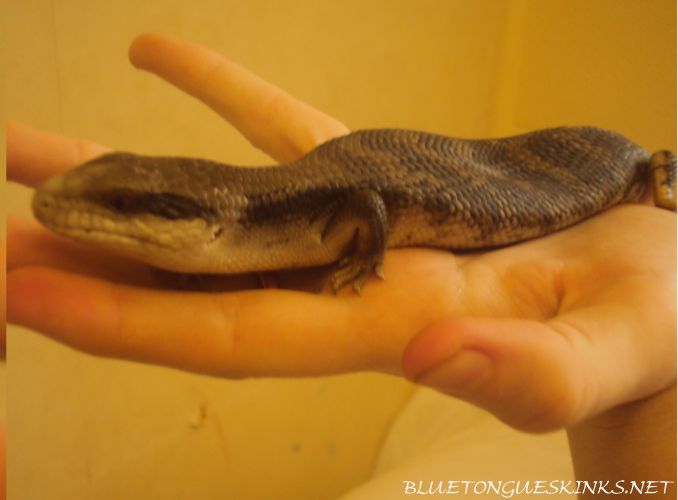
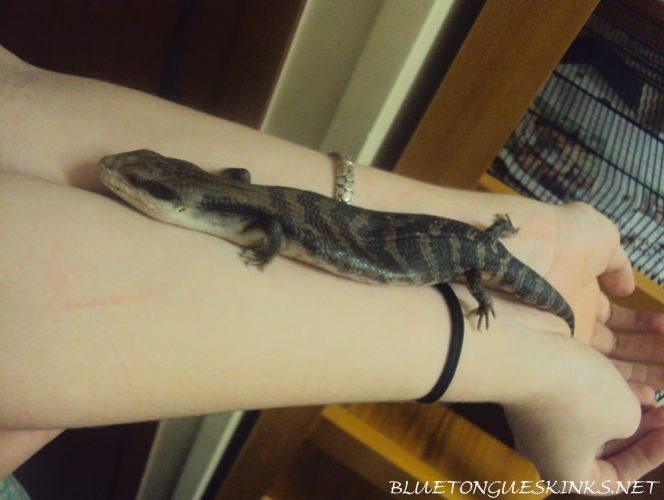
Fatal_S wrote:I'm going to go the other way and say it's not a birth defect, he's a climber. Meaning he's been climbing the walls of his tank and bending himself at 90*. It tends to leave that same dip, especially in animals where the bones are softer and they're underfed.
You cre correct in that wall climbing can definitely cause this sort of thing as well. However, it takes quite a bit of time to cause damage to that extent, and this looks like a pretty young animal. I have seen these birthdefects first hand as described in the following paragraph, and I still tend to think this is most likely a birth defect, as the similarities in this case and other cases I have seen in the past are too obvious for me to ignore.
Often spinal deformities in new-born neonate blue-tongues are incorrectly attributed to metabolic bone disease, but are actually often the result of what happens when gravid females are not given access to adequate basking temperatures. I have a friend who purchased a large, obviously gravid, blue-tongue from one of the big pet store chains (Petco). This large female was an imported Irian Jaya Blue-tongue that had been kept at room temperature for her two-month stay at the pet store. She gave birth to 10 baby skinks 1 day after she was brought home. These babies had spines that appeared to be too large for their bodies, causing many of them to be contorted into little C shapes that were twisted so that the rear ventral region was facing up. There were a couple of these little skinks whose bodies looked like inchworms, causing them to tip over onto their sides each time they attempted to move. The others were able to use their front legs to crawl in circles. Three of the babies died shortly after birth, and the remaining seven were given to me in hopes that I could keep them alive. Most Vets do not give a very optimistic prognosis for babies born with these deformities, and freezing them was recommended as the best alternative. However, my wife was able to keep 4 of the original 7 alive by hand feeding and watering them every day. It was not long till most of them were eating on their own, although they still were hardly mobile. In time as they grew, their bodies seemed to accommodate their spinal deformities, allowing them to straighten out to some extent. Two of them appeared almost normal, having only curly tail tips as a reminder of their previous disability, while the others had wavy spines of various degrees. Although many people suggested that we put them down, these baby skinks fought hard to live, and have all been adopted out to good homes. I mention this situation as an example of what can be avoided by simply providing a proper basking site for gravid females.
As fatal S mentioned, spinal deformities can also result in skinks that try to climb up one of the corners of their glass cage, forcing their mid-body into that L shape that you described. When skinks stay in this kind of an unnatural position for long periods of time, on a regular basis, spinal deformities may result. This behaviour is usually caused by something lacking in the skink's environment causing it to attempt an escape. It could be due to improper temperatures, or the skink may be feeling vulnerable, causing it to seek adequate shelter. Skinks do not understand glass as a solid object, which is why some "unhappy" specimens keep climbing up the same corner over and over. If your skink does this, try to find out what is wrong with the enclosure, and you may also want to consider a custom cage with solid walls.