
Not sure what happened to the last topic I had on here but i'll try again.
Is fir tree shavings safe for a bluey? I feel like I read before it wasn't good for them. But it is the only bedding directed towards reptiles in my area. My guy has been seen eating Aspen shavings so I have to change his current bedding.
What happened?
Forum rules
In this forum all are welcome to ask blue tongue skink-related questions, share information, ideas, tips, experiences, and pictures with fellow BTS enthusiasts.
If you are wondering if your BTS is acting normally or might be sick, this is where you can get help with that.
This is also where you can have some FUN while sharing the enjoyment you get from your blueys!
In this forum all are welcome to ask blue tongue skink-related questions, share information, ideas, tips, experiences, and pictures with fellow BTS enthusiasts.
If you are wondering if your BTS is acting normally or might be sick, this is where you can get help with that.
This is also where you can have some FUN while sharing the enjoyment you get from your blueys!
-
Kendall_fraser
- Bluey Beginner

- Posts: 30
- Joined: Thu May 12, 2011 5:52 pm
- Country:
- Location: Nova Scotia, Canada
-
James Wilson

- The Mentor

- Posts: 693
- Joined: Mon Feb 16, 2004 8:01 am
- Country:
- Location: San Diego, California
I must apologize as I think I somehow deleted the whole thread by accident. I was replying to two different posts (one being yours), and when I replied, I accidently cut and pasted the text from the reply to the other post into my reply to your post. Once I realized it, I went to edit the post and there was a delete option, so I deleted it. I immediately got a big error page saying I could not do that, but when I went back to the discussion forum, I saw the thread was totally gone. I am at a loss as to how I was able to do that, but I am really sorry. Anyway, here are my thoughts on the subject.
There are many different opinions on the subject of substrate. I have personally tried many of them myself, and I have found that artificial-turf has proven to be a very effective substrate for me. Cypress mulch and carefresh is also frequently used and recommended by many keepers. Aspen Bedding has been used by many hobbyists, but some types contain long sharp slivers can work their way into the skinks nostrils, eyes, or vent, causing serious injury. It is also hard to keep it out of the skinks food, and can cause very serious problems when ingested. I also avoid orchid bark for the same reasons and because of the possibility of respiratory and skin problems as a result from the red dust that it produces. Note: Never use cedar chips due to the toxic oils that they secrete.
Blue-tongues will often burrow in their substrate if given the opportunity (especially when kept in a glass tank). They do this simply out of convenience, in an effort to get under something and out of sight from potential dangers. However, rather than being labeled as burrowers, it would be more accurate to refer to Blue-tongues to as opportunistic shelter seekers, as they do not need a substrate to burrow in if given appropriate hides and an enclosure that provides them with some sense of security. This is also the case in the wild where they are often found under pieces of wood and scraps of sheet metal in addition to in log hollows and under logs.
Sand is also not recommended, mainly because it is very hard to maintain. Blue-tongues can be very messy lizards, causing the sand to have a very unpleasant odor in a relatively short period of time, and it is just not practical to replace the sand as often as you will need to. It is often pointed out to me that sand is often encountered in the wild by many blue-tongue species. However, that does not change the fact that it can get into your skinks eyes, nose, and food, unnecessarily causing potential health risks to your skink. The reason for this is that in the wild the skink is not forced to be in constant contact with the sand 24 hours a day, for its entire life, as it would be in captivity. Let me try to explain. Many of the lizards from the south-western United Stated come in close contact with many different Cactus species. However, cactus is not the best choice of cage décor for these lizards in captivity. The point is, just because something is encountered in the wild, does not automatically make it beneficial in captivity. In captivity we should try to duplicate the beneficial aspects of the wild while decreasing the dangerous and rigorous aspects that the wild also presents.
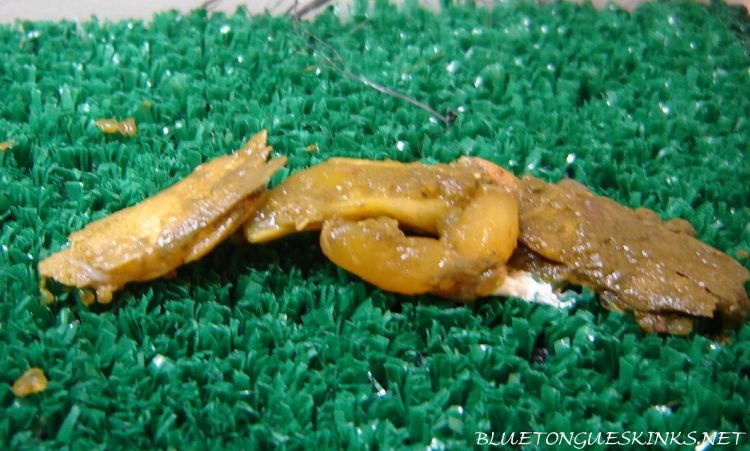
UPDATE NOTE: I generally do not recommend using Aspen, but I decided to break my own rule and use it in a special circumstances situation with my gravid female so she could have some "nesting" materials, and so that the babies could have a place to hide if they were born when I was not home. It turned out I was home, so no worries there. That being said, the mother ended up eating lots of the shavings. I did not notice until I removed the shavings when I was switching her back to her regular turf. While digging through all of the shavings I noticed her feces were filled with chunks of aspen. A couple days ago she made a really big poop that was filled with large pieces of aspen. Today she made another nice poop after a nice treat of jackfruit, and there are still some aspen shavings in there (see photo). I will never use it with bts again. I am giving my large sack of aspen to a local reptile rescue.
There are many different opinions on the subject of substrate. I have personally tried many of them myself, and I have found that artificial-turf has proven to be a very effective substrate for me. Cypress mulch and carefresh is also frequently used and recommended by many keepers. Aspen Bedding has been used by many hobbyists, but some types contain long sharp slivers can work their way into the skinks nostrils, eyes, or vent, causing serious injury. It is also hard to keep it out of the skinks food, and can cause very serious problems when ingested. I also avoid orchid bark for the same reasons and because of the possibility of respiratory and skin problems as a result from the red dust that it produces. Note: Never use cedar chips due to the toxic oils that they secrete.
Blue-tongues will often burrow in their substrate if given the opportunity (especially when kept in a glass tank). They do this simply out of convenience, in an effort to get under something and out of sight from potential dangers. However, rather than being labeled as burrowers, it would be more accurate to refer to Blue-tongues to as opportunistic shelter seekers, as they do not need a substrate to burrow in if given appropriate hides and an enclosure that provides them with some sense of security. This is also the case in the wild where they are often found under pieces of wood and scraps of sheet metal in addition to in log hollows and under logs.
Sand is also not recommended, mainly because it is very hard to maintain. Blue-tongues can be very messy lizards, causing the sand to have a very unpleasant odor in a relatively short period of time, and it is just not practical to replace the sand as often as you will need to. It is often pointed out to me that sand is often encountered in the wild by many blue-tongue species. However, that does not change the fact that it can get into your skinks eyes, nose, and food, unnecessarily causing potential health risks to your skink. The reason for this is that in the wild the skink is not forced to be in constant contact with the sand 24 hours a day, for its entire life, as it would be in captivity. Let me try to explain. Many of the lizards from the south-western United Stated come in close contact with many different Cactus species. However, cactus is not the best choice of cage décor for these lizards in captivity. The point is, just because something is encountered in the wild, does not automatically make it beneficial in captivity. In captivity we should try to duplicate the beneficial aspects of the wild while decreasing the dangerous and rigorous aspects that the wild also presents.
UPDATE NOTE: I generally do not recommend using Aspen, but I decided to break my own rule and use it in a special circumstances situation with my gravid female so she could have some "nesting" materials, and so that the babies could have a place to hide if they were born when I was not home. It turned out I was home, so no worries there. That being said, the mother ended up eating lots of the shavings. I did not notice until I removed the shavings when I was switching her back to her regular turf. While digging through all of the shavings I noticed her feces were filled with chunks of aspen. A couple days ago she made a really big poop that was filled with large pieces of aspen. Today she made another nice poop after a nice treat of jackfruit, and there are still some aspen shavings in there (see photo). I will never use it with bts again. I am giving my large sack of aspen to a local reptile rescue.
James Wilson
Return to “General Discussion and FAQ”
Who is online
Users browsing this forum: No registered users and 200 guests