
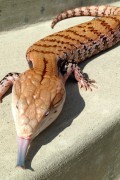
My BTS was a rescue from Halls Gap Victoria. I've had him for a couple of months and i just adore him! he is super friendly and active and has a good appetite. I have noticed a couple of things i'd like a second opinion on. One of his toes seems to have retained skin from a previous shed. Should i soak it and pick it off or leave it to him? He hasnt shed since ive had him so not sure what to expect.
Also i have noticed tiny dents/pits forming in some of his scales. Is this a humidity problem or mites? I haven't seen any mites on him.
Lastly his little tail appears to have been squashed (by a car im guessing) just wanting to double check it is an injury and not a sign of health problems.
Thankyou! <3
Looking for help identifying toe and scale abnormalities
Forum rules
In this forum all are welcome to ask blue tongue skink-related questions, share information, ideas, tips, experiences, and pictures with fellow BTS enthusiasts.
If you are wondering if your BTS is acting normally or might be sick, this is where you can get help with that.
This is also where you can have some FUN while sharing the enjoyment you get from your blueys!
In this forum all are welcome to ask blue tongue skink-related questions, share information, ideas, tips, experiences, and pictures with fellow BTS enthusiasts.
If you are wondering if your BTS is acting normally or might be sick, this is where you can get help with that.
This is also where you can have some FUN while sharing the enjoyment you get from your blueys!
-
Billimina
- Bluey Beginner

- Posts: 1
- Joined: Wed Jul 01, 2015 6:58 am
- Country:
- Location: melbourne
Looking for help identifying toe and scale abnormalities
You do not have the required permissions to view the files attached to this post.
-
Susann
- ADMIN

- Posts: 4022
- Joined: Mon Mar 22, 2010 12:06 pm
- Country: USA
- Location: Utah
Re: Looking for help identifying toe and scale abnormalities
As nobody with Shinglebacks have responded yet, I will say that, it looks an awful lot like our tropical skinks' scales do when they get dehydrated... But I know absolutely NOTHING about Shinglebacks and am hoping someone with experience can shed better light on it for you.
Breeder and keeper of Meraukes from 2010 to 2022.
-
Dakota

- Snail Hunter

- Posts: 5212
- Joined: Fri Mar 01, 2013 3:30 pm
- Your Facebook name: Dakota Nivens
- Country: US
Re: Looking for help identifying toe and scale abnormalities
It is natural for T. rugosa to have very irregular, corrugated scales like that.
What is his weight like? I remember someone rescuing a Shingle with a tail like that. It ended up being too skinny - all the fatv reserve was deplenished from that tail, making it look like that.
But like Susann, I certainly do not have any first-hand knowledge when it comes to Shingles.
What is his weight like? I remember someone rescuing a Shingle with a tail like that. It ended up being too skinny - all the fatv reserve was deplenished from that tail, making it look like that.
But like Susann, I certainly do not have any first-hand knowledge when it comes to Shingles.
"The love for all living creatures is the most noble attribute of man." — Charles Darwin
-
Richard.C

- Kimberley Klan

- Posts: 10474
- Joined: Mon Oct 10, 2005 3:37 am
- Country:
- Location: melbourne australia
Re: Looking for help identifying toe and scale abnormalities
A rescue from halls gap?
Im not sure if you are aware of the legalities of that,but shingles ate sn on licence specues in victoria and arent supposed to be taken from the wild,even if they appear to need rescuing,many dont need rescuing and if they do they are supposed to go to a wildlife shelter/carer
Anyways back on topic,tail tips a sign of fat reserves down a bit,the tip flattens first on asperas,if hes eating well that should fill back out before long,the toe issue is possably from retained shed,though could be from injury to,most likely retained shed though
Dimples in back may have already been there,and u may havr only just recently noticed them,being roguse of scale you often have to look close to see such markings,again probsbly old scarring,a female i have has same thing on her shoulders from males biting her for mating,i never saw wounds like in bluetongues where they can scuff easily,but shibgle scales are slot differeny and they would likrly go unnoyiced but dimples may form from the healing
Im not sure if you are aware of the legalities of that,but shingles ate sn on licence specues in victoria and arent supposed to be taken from the wild,even if they appear to need rescuing,many dont need rescuing and if they do they are supposed to go to a wildlife shelter/carer
Anyways back on topic,tail tips a sign of fat reserves down a bit,the tip flattens first on asperas,if hes eating well that should fill back out before long,the toe issue is possably from retained shed,though could be from injury to,most likely retained shed though
Dimples in back may have already been there,and u may havr only just recently noticed them,being roguse of scale you often have to look close to see such markings,again probsbly old scarring,a female i have has same thing on her shoulders from males biting her for mating,i never saw wounds like in bluetongues where they can scuff easily,but shibgle scales are slot differeny and they would likrly go unnoyiced but dimples may form from the healing
-
Scotts1au

- Great Scott
- Posts: 4362
- Joined: Tue Nov 13, 2007 2:19 am
- Country:
- Location: Central Victoria, Australia
Re: Looking for help identifying toe and scale abnormalities
It is normal for a wild shingleback.
Adults nearly always have scrapes, bang, scarring, ridged scutes etc associated with the rigours of living in the wild and developmental stresses.
The absence of these sorts of blemishes are indicators of domestically raised vs. wild caught animals like this one.
Adults nearly always have scrapes, bang, scarring, ridged scutes etc associated with the rigours of living in the wild and developmental stresses.
The absence of these sorts of blemishes are indicators of domestically raised vs. wild caught animals like this one.
If you wait, all that happens is that you get older. M. Andretti
Return to “General Discussion and FAQ”
Who is online
Users browsing this forum: No registered users and 181 guests